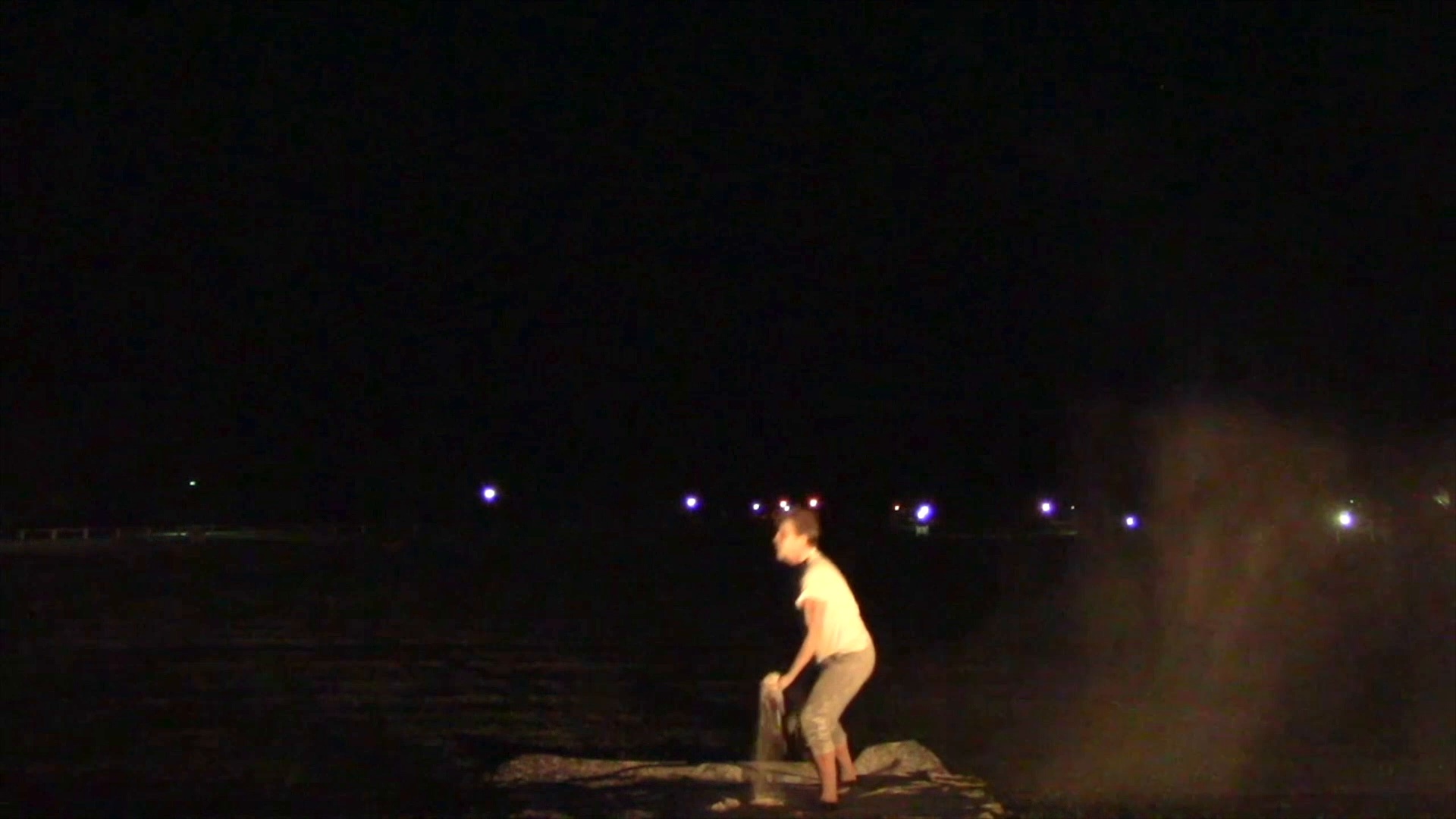
Statements necessarily offer contingency, ambiguity, and opacity.
Dance is more than a language, but not in a way I think I can fully understand.
The beginning is not the best place to start.
To produce a trace, I don't need to leave a mark.
Everything is a sign of something else, except
Objects on my screen are more distant (and less stable) than they appear.
Boundaries are arbitrary, and those between movement, image, sound, and text mystify the senses.
I prefer wandering around to wandering through.
Stillness is the most compelling form of movement.
I struggle to make a habit of inconsistency.
Failure is an aesthetic choice.
Improvising reinvents my future in my present through my past.
Blue is more than just a color.
I try to make it my self.
Self contradiction is to be expected — especially here in America.
My complicity is inevitable — and thus critical.
The art's politics should exceed the artist's.
If my experimentation succeeds, something should shift, even if I can't quite name it.
Authenticity is mostly a comfortable illusion — better to be uncomfortable.
Indeterminate algorithms compel my recorded images and live movement to surprise each other.
Randomness is evidence that there is always a chance.
My means should resist my end(s).
Embodiment is the problem, the solution, and always a question.
I can count higher than one.
Repetition is the only path toward change.
My situation requires action.
Tyler Walters spent nearly four decades in professional ballet — as a leading dancer with the Joffrey Ballet and subsequently as an educator and award-winning choreographer — before rupturing with almost everything that tradition embodies. His current work engages the tensions between materiality and virtuality, presence and absence, language and the body's resistance to it, merging improvisational movement with algorithmically processed video and sound to interrogate the American capitalist myth of the sovereign, self-determining individual.
That rupture found its form at Hollins University, where Walters earned an MFA in Dance in 2017. There he began developing a praxis grounded in theoretical research, personal excavation, social self-implication, and formal experimentation. His thesis performance, notwhatiusedtobe, a live performance and media installation exploring identity, memory, and change through the Narcissus myth and ephemeral projection onto falling water, established the research agenda that continues to drive his work: the unstable self, the journey as both physical and psychic proposition, the critique embedded in and through his complicit white American embodiment.
Since then, Walters has pursued this agenda across two primary modes of working. He continues to develop The Elusive Self, an ongoing series of solo video installations in which algorithmically controlled playback generates multiple simultaneous instances of the same recorded movement — durational rather than looped, without predetermined beginning, middle, or end — quietly dismantling the illusion of a singular, coherent self. Works in the series, including Kitchen Pas de Deux (2020), auto/mobile (2023), and Unsettler: go back where you came from / Hydrologic Cycle #2 (2022), have been presented in intimate venues in Chapel Hill and Durham, NC, as well as in virtual installations online. In parallel, under the collaborative appellation Negative Mirror — taken from Italo Calvino's Invisible Cities — Walters and co-director Killian Manning have created a series of intermedial performance events that bring together live movement improvisation, algorithmically manipulated video and sound, spoken text, and immersive installation. Their most recent work, Forces of Habit (2026), a three-part performance examining the social, pathological, and potentially liberatory dimensions of habitual behavior, was presented in Chapel Hill, NC.
Across both modes, recurring concerns surface and resurface: embodiment as site of social critique, the journey as metaphor for psychic and political becoming, the narcissism embedded in American self-fashioning, and the productive instability of meaning in a culture that prefers its certainties undisturbed. Walters makes his work himself — developing algorithms, building soundscapes, making and editing video, constructing physical installations, and performing in almost everything he makes — finding that fluency across media is vital to the integrity of the work.
He remains Associate Professor of the Practice Emeritus of Dance at Duke University, based in the Research Triangle area of North Carolina.