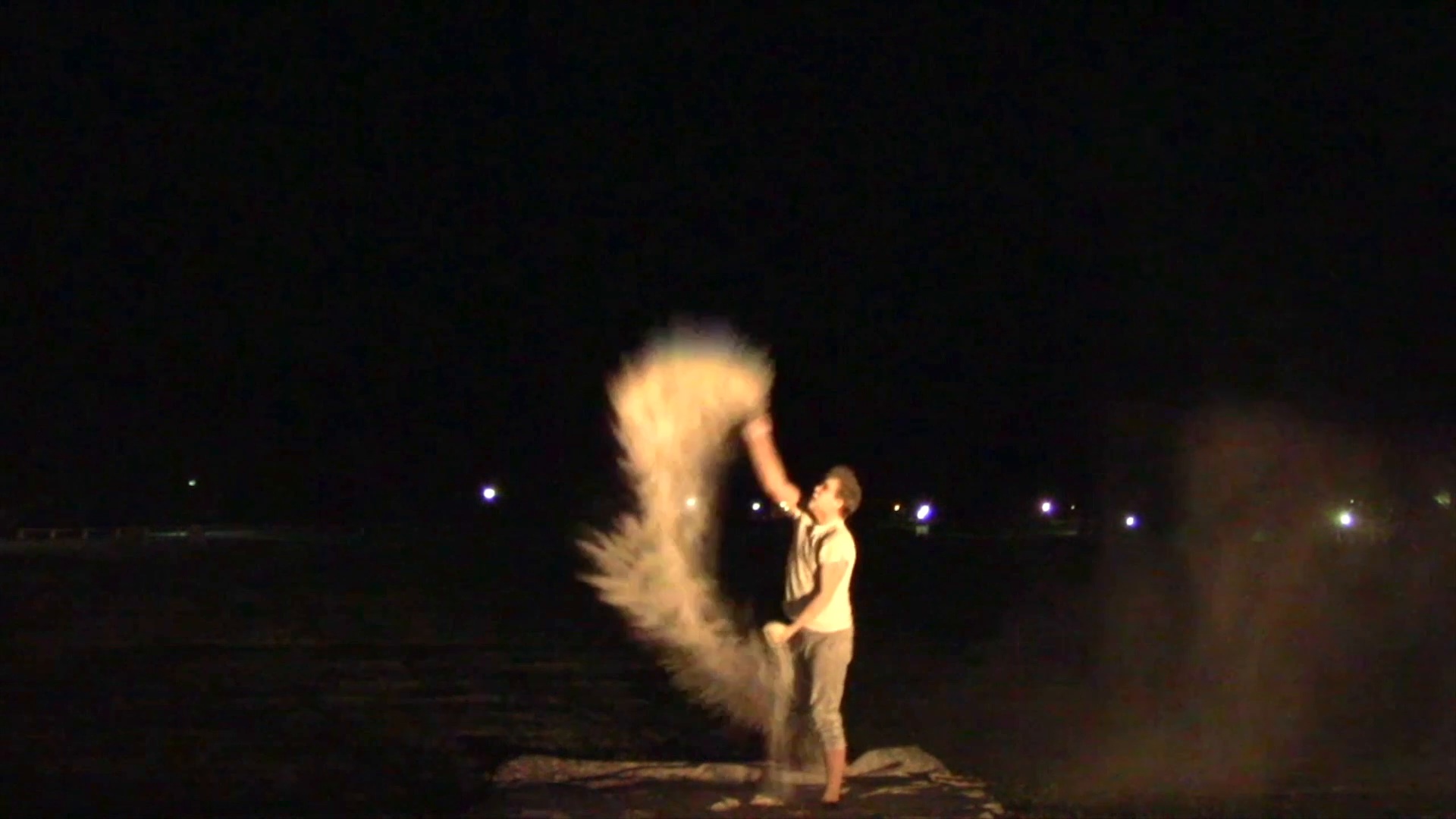
SkyTy (2016) is a site-specific solo performed at night in an open field. Seated behind a mound of baking flour, the performer slowly gathers the powder, rubbing it onto his skin before rising to throw large handfuls overhead, creating a momentary cloud onto which a live-processed, vertically inverted video feed of the same actions is projected in real time. The virtual image exists only as long as the material that receives it remains airborne — each throw producing and almost immediately dissolving its own screen. What emerges unexpectedly from this recursive loop of action, material, and image is a figural presence hovering above the performer — a ghostly double that reads simultaneously as reflection, apparition, and deity conjured in the performer's own image. The performance ends as it began — the performer returning to the ground, lying down in the residual flour, the virtual double dissolved. Inspired in part by theorist Steve Dixon's concept of the "digital double," SkyTy implicates questions of narcissism, self-construction, and the mutual dependence of the virtual and the material, while resisting any stable resolution of these into meaning.
Foundational Works
notwhatiusedtobe (2017) is a live performance and media installation created as a thesis project at Hollins University, performed at night in an outdoor garden site. A custom-built pool and fountain installation — its apparatus deliberately visible — supports three recorded video images of the performer projected onto falling water droplets and the reflective pool surface, creating a layered, unstable field of past and present selves into which the living figure gradually, physically immerses. Drawing on the Narcissus myth, the river metaphor of Heraclitus, and the Greek personifications of memory and forgetting, Mnemosyne and Lethe, the work moves through three sections: a comic, self-aware opening dialogue between live and recorded selves about change, identity, and the performer's complicity in Western artistic traditions; a darker passage structured around Echo — in which a commanding recorded self-image issues instructions whose digitally produced echoes progressively alter their meaning, while the live performer struggles to follow them literally; and a reflective passage, culminating with the living figure kneeling over his own prone projected image, disturbing the pool's surface with his hands, and pouring water over the image before exiting through the falling water into darkness. Beginning in a dry white linen suit and ultimately becoming fully immersed, the performer's trajectory through water enacts the work's central inquiry: not what he used to be, the self emerges from this encounter with its own image neither clarified nor resolved, but changed — and still changing.
The Elusive Self
The Elusive Self is an ongoing series of algorithmically durational video installations exploring the instability of personal identity within American consumer culture. Each work layers multiple simultaneous instances of the same recorded movement improvisation, with an indeterminate algorithm controlling the speed and direction of playback independently for each — generating perpetual, unrepeatable recompositions of the same material. Rather than looping a fixed sequence, the works have no predetermined beginning, middle, or end, unfolding differently with each viewing. A spoken text, similarly parsed and randomized, accompanies each work — its phrases drawn from or written in response to the specific cultural terrain each piece inhabits. Across the series, the multiplication of the moving figure quietly dismantles the illusion of a singular, coherent self, while the algorithm's indeterminacy ensures that the self, however many times it appears, remains just out of reach.
boxed in / i object places a live performer and a large cardboard box inside a system that watches, analyzes, and names — continuously, confidently, and without knowing what it has found. A computer vision algorithm runs in near-real time, generating bounding boxes that chase and surround whatever moves in the frame: flickering rectangles that multiply, stabilize briefly with labeled confidence scores, then fade. The concept of the box is nested: a human inside a physical cardboard box inside a bounding box inside a projection screen frame inside a rectilinear performance space — each a different kind of container, each proposing a different relationship between object and frame. Pose estimation figures and body part labels also come and go. The system does not distinguish between the live performer and the digital doubles projected alongside them — up to four virtual figures tracked with the same attention, the same indifference. Accompanying the visual accumulation is a spoken text: a series of glossary entries, each offering a technical definition followed by a commentary that quietly undermines it. Bounding box: a rectangle placed over an image region, inscribing an object's position and dimensions. The rectangle does not negotiate its edges. It does not ask whether the object agrees to be contained. The voice delivering these entries shifts across the duration of the work — from early robotic synthesis through increasingly naturalistic AI speech, arriving finally at something uncannily smooth. At roughly the midpoint, the entries shift from third person to first. The system begins speaking as I. boxed in / i object is the first work in the elusive self series in which the self is not only multiplied or set in motion by an algorithm but named by one — held in place by a system that categorizes without understanding, and identifies without knowing what it has found.
Kitchen Pas de Deux sets two simultaneous instances of the same improvised movement sequence loose in a meticulously renovated domestic kitchen — a space that is at once intimately personal and aspirationally perfect. The figures move through, around, and occasionally into each other, their trajectories determined independently by a randomizing algorithm that sends each forward, backward, fast, or slow without coordination or predetermined outcome. The accompanying audio — phrases extracted and randomized from a 1950s General Electric promotional video for the modern electric kitchen — cycles through the room's implied promises of domestic perfection, convenience, and feminine labor with a deadpan irony that the moving figures quietly embody and resist. The work emerged from a coincidence of concerns: the stickiness of traditional gendering of domestic space, the American obsession with home improvement and domestic perfection, and a growing personal ambivalence about how we inhabit — and are inhabited by — the spaces we make for ourselves. That the kitchen was built by the same hands that move through it adds a layer of self-implication the work neither explains nor resolves. Also available as Kitchen Quintet (2024) — an alternate version integrating a live performer among four virtual ones, presented at Shadowbox Studio, Durham, NC.
unsettler places three instances of the same figure on a North Carolina beach at sunset, each drifting gradually — through the indeterminacy of forward, backward, fast, and slow — toward the Atlantic shoreline, fading as it reaches the water and reappearing at the edge of the land to begin again. The movement is always tending toward the ocean — the same ocean from whose shores European settlers first came ashore in the "new world" — making the subtitle's imperative, usually directed at immigrants and people of color, into a gesture of inverted manifest destiny: loaded, futile, and necessary simultaneously. The spoken text, written by the artist in a near-whisper as if from inside his own head, moves between the childishly simple and the philosophically vertiginous, asking questions that range from the quotidian to the existential without resolving either. Created during a self-fashioned artist retreat on the North Carolina coast in early 2022, the work offers three readings of its titular neologism: the one who unsettles, invoking mortality and the inevitability of change; the one who will not settle for less, demanding something meaningful in the face of impermanence; and the one who enacts a kind of reckoning with colonial history, knowing the gesture changes nothing and making it anyway.
In auto/mobile, two instances of the same figure move restlessly through the interior of a car — pressing against the windshield, spilling between front and back seats, occasionally breaching the vehicle's boundaries entirely — while the road beneath moves steadily, imperceptibly, in reverse. The car, that most American of emblems — freedom, power, speed, self-determination — is going backward while appearing to go forward, its mythology of progress quietly undermined by the direction of its own travel. The accompanying audio, extracted and randomized from a vintage automotive promotional video, cycles through the era's breathless promises of liberation through horsepower and chrome. The work implicates its maker directly: the car is the artist's own, its necessity unquestioned in the suburban life it sustains, its environmental cost equally unquestioned in the daily convenience it provides. The figures' restless movement — awkward, cramped, occasionally struggling against the vehicle's constraints — suggests less the freedom of the open road than the discomfort of a myth that no longer quite fits.
in two easy steps places two instances of a nude figure — seen always from behind, face never visible — on an endless road that travels through collaged landscapes: forest, desert, bridge, tunnel, star field, mathematical equations, planetary nebula, each pixelating into the next. One figure glows white, a luminous silhouette; the other shifts gradually between material fills — confetti, bubbles, clouds, disco ball — its nudity present but refracted, festive and unresolved. Both walk toward a vanishing point they will never reach, their movement controlled by an indeterminate algorithm that sends each forward, backward, fast, or slow, the road beneath them always extending further than any number of steps can cover. The accompanying text — spoken in a dry, matter-of-fact voice — alternates randomized instructions from internet self-help guides with randomized recipe steps, generating non-sequitur collisions that are simultaneously absurd and unexpectedly coherent: "Step 1: Move from becoming somebody to becoming nobody / Step 2: Bake to the preferred doneness, turning halfway through." The work's title carries its irony lightly. Nothing about becoming — or unbecoming — is easy, and the two steps the title promises multiply endlessly without arriving anywhere. The two figures, one aspirational and luminous, one festive and material, suggest not two people but two versions of the same self: the ideal and the actual, walking side by side toward a horizon that keeps receding, accompanied by instructions that are perfectly clear and completely useless.
Negative Mirror
Negative Mirror is the collaborative appellation of Tyler Walters and Killian Manning, taken from a passage in Italo Calvino's Invisible Cities: "Elsewhere is a negative mirror. The traveler recognizes the little that is his, discovering the much he has not had and will never have." Formed in 2019 through sustained reading, argument, and creative research, the collaboration began with Calvino's Six Memos for the Next Millennium and Invisible Cities, developing a set of creative procedures that integrate live movement improvisation, algorithmically manipulated video and sound, spoken text, and constructed or reconfigured environments. Working primarily in an intimate studio space that is transformed for each event, Negative Mirror has produced a body of work that ranges from pure multimedia installation to large-scale intermedial performance, consistently implicating its audiences in the meanings it generates rather than presenting those meanings as fixed or complete.
The City: a project(ion) is a multimedia installation without live performers, emerging across seven oversized projection screens arranged throughout the studio space — each tilted ten degrees on every axis, set at different heights, and facing in different directions, so that no fixed viewing position can take in the whole. One screen requires lying beneath it; another demands an almost vertical upward gaze; another looks almost straight down. The audience stands, sits, reclines, or wanders, continuously reorienting their bodies to follow the work's distributed attention — navigating the installation as one navigates a city, which is to say: performing and producing the space simultaneously with moving through it. Eleven algorithmically sequenced video channels cycle across the seven screens — never duplicating exactly, always placing different content in adjacency — drawing on Italo Calvino's Invisible Cities for its visual and textual material: paper sheets bearing city designations falling past vertiginous skylines; astrolabes and navigation instruments on old maps; Calvino's aphorisms appearing on crumpling and unfolding paper; dancers moving through windows, walls, construction sites, satellite views of cities, and the cities themselves. An algorithmically randomized soundscape weaves Calvino's prose with spoken texts drawn from news, radio, political speeches, and podcasts spanning three decades. The City: a project(ion) is the fourth iteration of material originating in The City: a prelude (2020), Negative Mirror's first work, made during Covid isolation as a virtual installation.
be here now is an intermedial improvisational movement meditation on presence — physical, psychic, and virtual — and the relationships between these different modes of being and the present, past, and future. Presented in three episodes in an intimate studio space divided by floor-to-ceiling moveable panels, the work offers audiences a choice of perspective: each side of the divided room reveals a different aspect of the performance, partially occluded from the other, and audiences may cross between sides between episodes. At the center of the divided space, a large projection screen — capable of rotating on its vertical axis — shows a door repeatedly opening onto different scenes: live webcam feeds from randomly selected global locations, clouds, underwater, outer space, ghostly images of the performers themselves. The three episodes share the same movement, video, and sound elements but arrange them differently — present-tense, else-where, here-and-there — so that presence itself is experienced differently each time, never settling into a fixed relationship between body, sound, and image. The algorithmically randomized spoken text moves between the genuinely profound and the deceptively simple: "We are in the same now but not the same here," "Elsewhere is a negative mirror," "The ringing of the bell is the signal of impermanence." As the performers rotate the projection screen — returning it always, within seconds, to its original alignment — the work enacts what it contemplates: attention's perpetual drift from and return to the present moment, the here that keeps becoming elsewhere, the now that is always already then.
Chance / Choice is an intermedial performance event in three episodes that places the tension between randomness and agency — in art, in life, in the systems that govern both — at the center of its inquiry. The performance space is bisected by two large vertical projection screens and a physical door, through which the audience enters, forced by a table of instruction cards placed directly in front of it to choose — before the performance has officially begun — whether to go left or right. An electronically altered voice opens each episode with a sequence of algorithmically randomized statements that implicate the audience directly: "With your presence, you are implicated in the meaning of this event," "Your life is governed by chance, not choice," followed immediately by "Your life is governed by choice, not chance." Seven performers draw from the instruction cards — some adapted from Brian Eno's Oblique Strategies, some from Negative Mirror's own practice — announcing each card aloud and passing it through the ensemble until instructions accumulate, voices overlap, and the space escalates toward productive cacophony. A planted card — "Take a break" — eventually halts the chaos, and the process begins again with renewed attention. The projected images — playing cards falling, coins spinning, doors opening onto live webcam feeds from around the world, changing road signs, ghostly live-processed images of the performers — maintain the work's visual language of suspended indeterminacy throughout. Chance / Choice neither resolves its central paradox nor pretends to: the algorithm chooses the order of the statements that tell you choice is an illusion, and the performers choose how to respond to instructions that arrived by chance.
contain yourself is an intermedial improvisational performance event in three sections, presented in an intimate studio space shared by six performers and their audience. The work takes containment — literal, metaphorical, psychological, social — as its central proposition, asking what we hold, what holds us, and what happens when the container and the contained become indistinguishable. In the first section, performers move through the space with large translucent plastic bins — body parts disappearing inside them, figures emerging from them, transparent containers lowered over heads and torsos — while algorithmically randomized video alternates between banal household activities of storage and ghostly processed images of the performers themselves. An algorithmically parsed spoken text accumulates: "Bottle the fluid thirst for fulfillment," "Encase indecision in the hardest shell of impenetrable avoidance," "Stow a cargo laden with loss, and longing," "Contain yourself." The second section offers three solos of increasing abstraction, each performed in the round beneath the central projection screen while the other performers slowly walk the perimeter of the space, unfurling long strips of muslin until performers and audience are enclosed within its border — then rolling themselves, mummy-like, for the duration of the final solo. The three solos — one with an urn that functions simultaneously as life container and death vessel; one set to readings of Sylvia Plath's "Mirror" and Linda Pastan's "Narcissus at 60," ending with the performer splashing water on her face and speaking her own words live; and one in which a performer is seen only on screen, moving between chair and standing in a self-choreographed meditation on his father's declining capacity, to his own reading of Mary Oliver's "The Uses of Sorrow" — form an arc through different registers of human limitation and endurance. The third section returns all performers to the space with large paper lawn bags, the intimate fragility of the new containers replacing the clinical transparency of the first, as the impossible inventory of what we carry resumes.
Forces of Habit is a live performance and media event in three parts, presented in a large studio space transformed into an immersive site in which five performers, five large projection screens, and the audience share the floor. The work examines habit — its social function, its pathological potential, and its largely unexplored capacity for creative liberation — across three sections that move from the monumental to the manic to the quietly transformative. The first section, Good Habits Make Good Citizens, opens with performers constructing scaled models of civilization's monuments — Stonehenge, the pyramids, a church pulpit, a highway, a courtroom, a watchtower, a border wall — while projection screens show algorithmically collaged video of everyday habituated tasks and a spoken text offers self-help advice about proper habit formation with a deadpan authority that barely conceals its ideological content. The second section, When Good Habits Go Bad, escalates into compulsion — highly repetitive, agitated movement sequences alongside projection screens showing popular culture's catalogue of addictive behaviors. The third section, fall seven times; get up eight, draws on the philosophies of habit developed by Henri Bergson, Gilles Deleuze, and Elizabeth Grosz to suggest the possibility of habits formed not through mindless repetition but through attention and choice — habits that make space for change rather than foreclosing it. As the performers improvisationally shape, repeat, and gradually transform brief movement sequences, the projection screens show live processed images of the performance itself — delayed, layered, amplified through motion detection — the work turning at last to look at its own making, finding in that reflection not a mirror but a negative one.